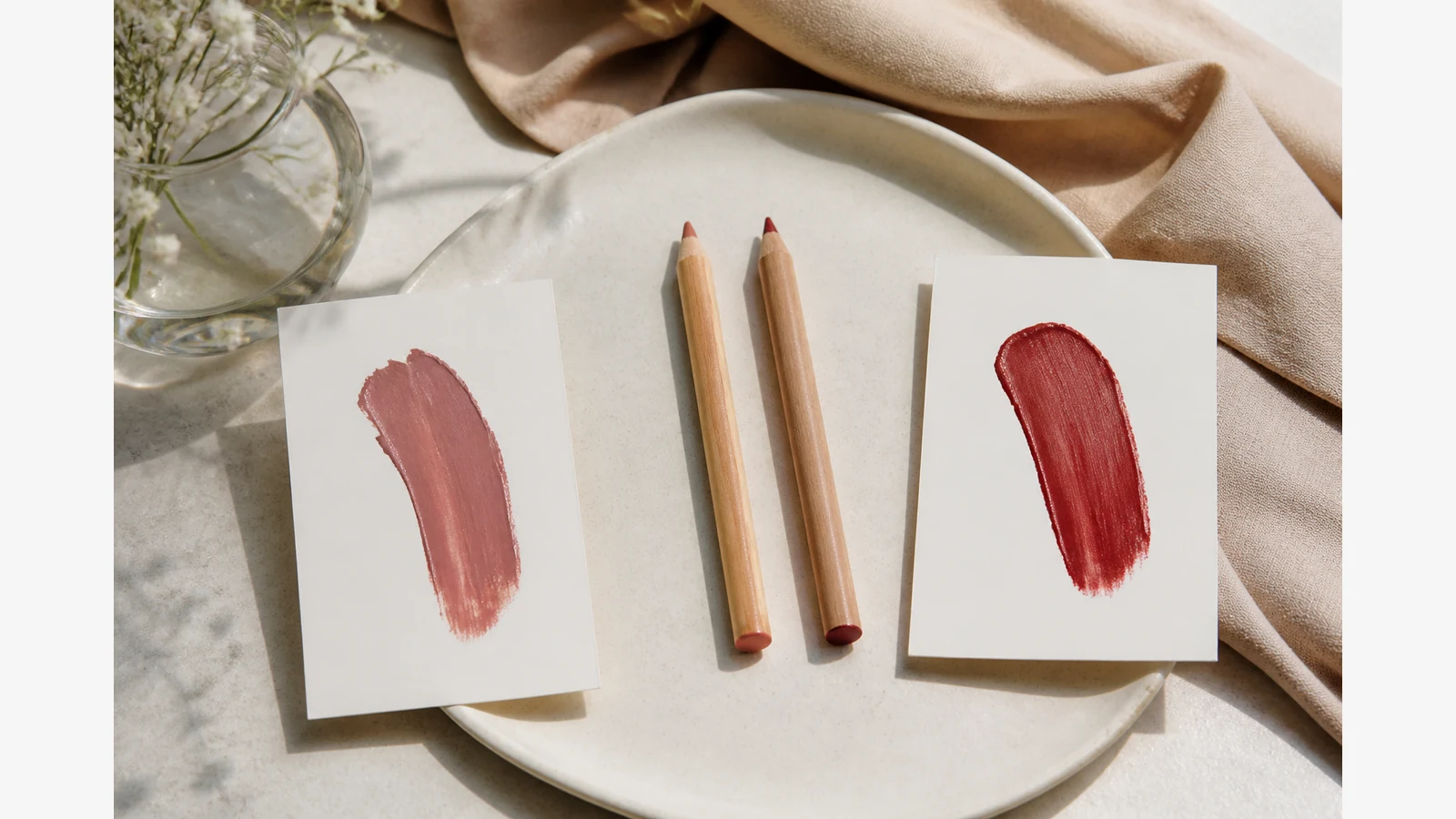
Should Lip Liner Match Lipstick Or Natural Lip Colour
Either reference can work. Match lip liner closer to your natural lip colour for a soft, blended everyday edge, or match it to your lipstick family when you want a crisper, more deliberate outline. There is no single “correct” rule—only the contrast and finish you want.
When a natural-lip reference works best
Starting near your own lip colour keeps the edge quiet. Official shade guidance often suggests beginning close to natural lip colour and adding contrast gradually, rather than jumping straight to a dramatic mismatch. That approach suits soft glam, sheer finishes, and days when you want definition without a sharp colour frame.
- Pick a liner that sits in the same depth family as your bare lips (similar lightness or darkness).
- Keep undertone roughly aligned: if your lips lean peachy or rosy, stay in that direction.
- Blend the inner edge of the line slightly toward the centre so the outline melts rather than stamps.
When a lipstick reference works better
Pairing guides from professional makeup brands typically show complementary liner and lipstick families—not a universal exact-match rule. Matching (or sitting one step deeper in) the lipstick’s colour family helps when you want a clean red, berry or nude statement edge that reads intentional under gloss, satin or matte colour.
- Identify the lipstick’s visible family: warm nude, cool nude, blue-red, orange-red, berry, mauve.
- Choose a liner in that family at equal or slightly deeper depth.
- Decide whether you want a crisp outline or a softly feathered boundary before you apply colour.
For reds specifically, undertone pairing matters more than “exact same tube.” See how to pair lip liner with red lipstick by undertone.
Undertone and depth checklist before you swatch
- Look at bare lips in daylight: note warmth (peach/coral) versus coolness (pink/berry).
- Swatch the lipstick on the back of your hand only as a rough guide; confirm on lips.
- Place a thin liner stroke beside the lipstick—do the two share a colour family, or do they fight?
- Check depth: a much deeper liner can look intentional; a much lighter one can wash the edge out.
- Always read the product label for ingredients and use instructions; shade advice does not replace labelling. UK guidance on cosmetics emphasises clear product information on consumer products.
Decision table: which reference to use
| Goal | Better reference | Edge style |
|---|---|---|
| Soft everyday definition | Natural lip colour | Diffused, blended inward |
| Bold lipstick with a clean frame | Lipstick colour family | Crisp or lightly refined |
| Sheer balm or gloss only | Natural lip colour (often) | Softly blurred |
| High-contrast evening lip | Lipstick family, often one step deeper | Defined, then optionally filled |
Mistakes to avoid
- Assuming every liner must exactly match the lipstick bullet—complementary families are normal.
- Choosing by packaging name alone; marketing names are not colour values.
- Skipping a daylight check after applying indoor lighting only.
- Building contrast so high that the rim looks disconnected once lipstick fades unevenly.
Application order also affects how the reference reads—liner-first versus lipstick-first is covered in lip liner before or after lipstick.
Next step
If you want to compare pencil options in a multi-shade set while you practise these references, you can review the current lip liner set details on this site. Use labels and your own swatches to decide; no article can guarantee a perfect match.
FAQ
Must lip liner always match lipstick exactly?
No. Exact matches can look polished, but complementary depth and undertone within the same family are widely taught as workable alternatives.
Is matching natural lip colour only for nudes?
It is most common for everyday and sheer looks, but it can also soften any colour that would otherwise look harsh at the border.
What if my lips are naturally two-toned?
Use the mid-tone of your lips as the natural reference, then adjust depth after a daylight check so neither half looks disconnected.